


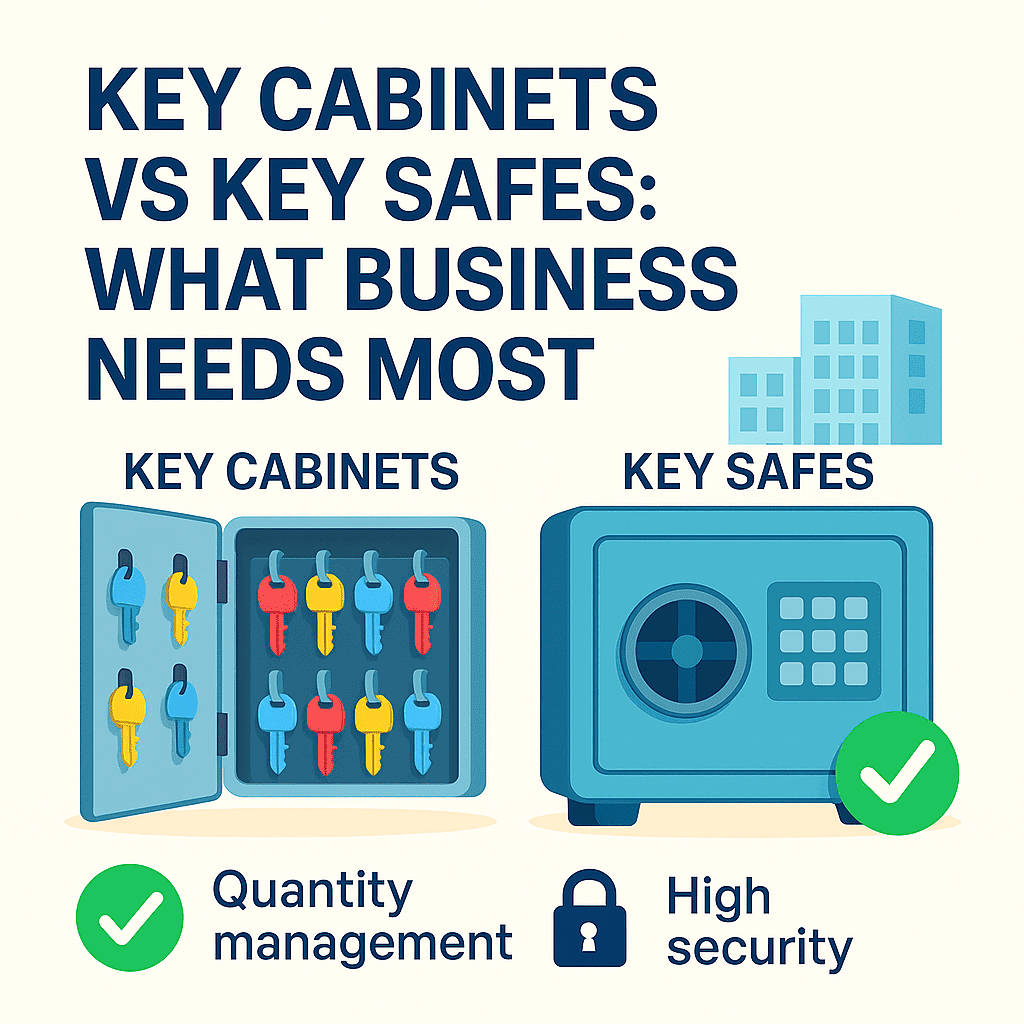
Why Key Storage Matters for Australian Businesses
Every business that handles multiple keys, whether for properties, vehicles, or secure rooms, needs a reliable system for secure key storage. Lost keys don’t just create headaches; they also expose your business to unnecessary risks and costs.
The choice often comes down to key cabinet vs key safe. But which one suits your specific needs? In this guide, we’ll break down the main differences in terms of security, capacity, accessibility, and cost, so you can make the best decision for your business. By the end, you’ll know which option is right for you and which models from Precision Safes can keep your business secure.
Key Cabinet vs Key Safe – What’s the Difference?
Key Safe: Compact and Convenient
A key safe is a smaller, lockable box (often wall-mounted) designed to hold a limited number of keys. They’re ideal for:
- Spare office keys
- Remote property access
- Short-term access for cleaners, contractors, or staff
Many models from our key safes collection are built with weather-resistant finishes, making them a smart choice for outdoor use in Australia.
Key Cabinet: Organised and Scalable
A key cabinet, on the other hand, is a larger unit with multiple hooks or slots for dozens or even hundreds of keys. They’re perfect for:
- Car dealerships
- Real estate agencies
- Hotels, hospitals, or facilities with multiple secure rooms
At Precision Safes, you’ll find both key safes and key cabinets under one category, highlighting how closely related they are, while serving different scales of need.
Capacity & Organisation
- Key safes typically store 10-30 keys, depending on the design. They’re compact, simple, and easy to install.
- Key cabinets are built for higher volumes: 50, 100, even 200+ keys. Many come with labelling systems, colour-coded hooks, or indexing features to keep everything organised.
For a growing business, capacity is one of the biggest deciding factors. If you’re managing multiple vehicles or properties, a cabinet is often the more future-proof investment.
Security Features & Access Control
- Key safes use digital PIN codes, mechanical combinations, or override keys. They’re often weatherproof for outdoor use.
- Key cabinets can include advanced systems: electronic PINs, audit logs, dual authentication, and even tamper alarms.
Both are made from durable steel with anti-tamper features, but cabinets provide more options for accountability and control in busy workplaces.
Accessibility & Workflow
- Key safes are perfect when you need fast, simple access. For example, a real estate agent meeting clients or a cleaner needing one-off property access.
- Key cabinets shine when keys are issued, returned, and tracked regularly. They create a centralised hub where staff or security teams can control access efficiently.
The right choice depends on whether you value convenience at the front line or structured management at the back office.
Cost & Installation
- Key safes are generally cheaper and easier to install. Most can be mounted on a wall or sturdy surface in minutes.
- Key cabinets cost more due to their size, locking tech, and construction. Some require structural support or professional installation.
However, for businesses managing 100+ keys, the per-key cost of a cabinet often works out cheaper than juggling multiple safes.
When to Choose a Key Safe
You’ll benefit most from a key safe if:
- You use a limited number of high-turnover keys (e.g. office doors, meeting rooms).
- You need off-site access for contractors or property management.
- You want a cost-effective, compact, and secure solution with minimal setup.
When a Key Cabinet Makes Sense
A key cabinet is the smarter choice if:
- You manage many keys across fleets, facilities, or multiple sites.
- You need audit trails, access logs, or multi-user control.
- You want a robust, centralised solution for high-security environments.
Hybrid Solutions: The Best of Both Worlds
Some businesses benefit from both:
- Key cabinets inside the office for central control
- Key safes at remote sites for selective, on-the-spot access
This hybrid setup gives you flexibility without compromising security.
Choosing the Right Model
When comparing models, keep these factors in mind:
- Key volume & growth: Always choose capacity above your current need to allow for expansion.
- Locking mechanism: Digital locks with audit logs are ideal for compliance-focused businesses.
- Durability & build quality: Look for solid steel, anti-tamper features, and corrosion resistance.
- Installation & placement: Ensure secure wall mounting or reinforced cabinet space for maximum protection.
Key Safe Security & Risk Mitigation
While both systems are secure, best practices matter:
- Mount to brick, concrete, or reinforced surfaces to prevent prying.
- Install discreetly, away from street view.
- Change PINs regularly and limit access to authorised staff.
- Use audit logging and alarms in cabinet models.
- Pair with CCTV or security lighting for extra deterrence.
As RACV notes, misuse or poor placement makes even a good safe vulnerable. Correct installation and smart use are key.
Ready to Secure Your Keys the Smarter Way?
Choosing between a key safe and a key cabinet depends on your business size, workflow, and security needs. For small volumes and quick access, safes are perfect. For larger operations needing tracking, scalability, and tighter security, cabinets are often the better investment.
At Precision Safes, we stock Australia’s largest range of key safes and cabinets, including trusted names like Guardall and CMI. Whether you need a compact key safe or a feature-rich cabinet, our team can help.
Browse our Key Safes & Cabinets here or contact us for expert advice. Secure your business keys with confidence today.
