

On this page
Why Professional Safe Installation Affects Your Insurance Cover
Most people buy a safe expecting it to do one job: keep their valuables secure. What they rarely consider is that the safe itself is only half the equation. How it was installed can determine whether an insurer honours a claim or rejects it outright. This is the buyer motivation almost nobody understands until a break-in has already happened and the claim comes back declined. Understanding how installation ties directly into your policy is the difference between genuine protection and a false sense of security.
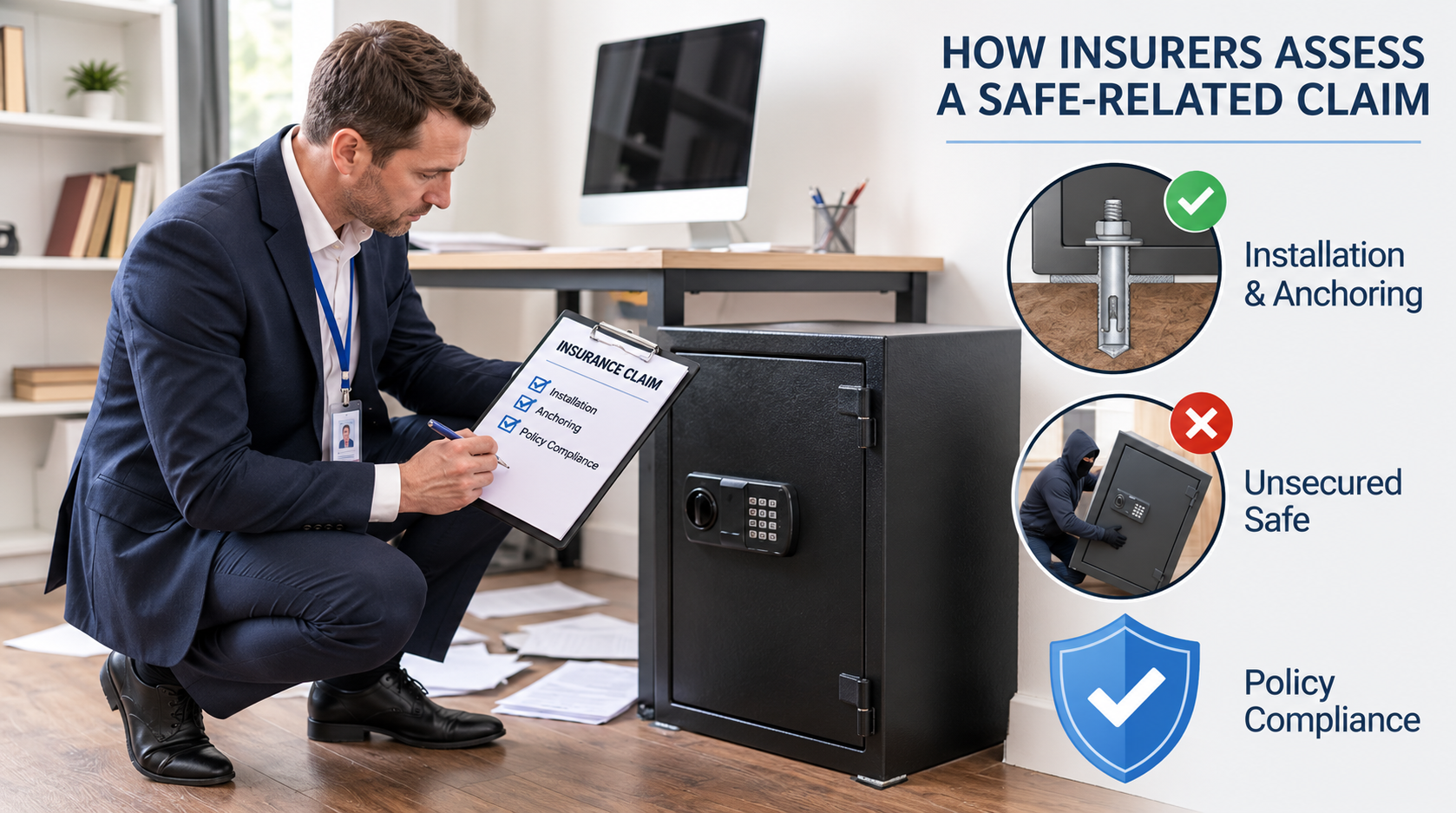
How Insurers Assess a Safe-Related Claim
When you lodge a claim for stolen cash, jewellery, or documents that were kept in a safe, the insurer does not simply take your word for it. They investigate whether the safe met the conditions written into your policy, and installation is one of the first things they examine.
Policy conditions and exclusion clauses
Most contents or business insurance policy carries specific conditions attached to high-value items. Many policies state that valuables above a certain threshold must be stored in a safe of a particular type, and increasingly that the safe must be professionally installed and anchored.
Buried within the fine print are exclusion clauses that let the insurer refuse a payout if those conditions were not met. An unanchored or incorrectly fitted safe can trigger one of these exclusions without the policyholder ever realising the risk they were carrying.
The evidence insurers rely on
Assessors build their decisions on evidence, not assumptions. After a burglary, they look at how the safe was attacked, whether it was carried away entirely, and how it had been fixed to the building. A safe that thieves simply lifted and removed tells the assessor that anchoring was inadequate.
Photographs, the physical damage at the scene, and any installation records all feed into the assessment, which is why the paper trail behind your installation matters as much as the safe’s steel.
Installation method under scrutiny
The method used to fit the safe often becomes the deciding factor. Insurers want to see that the unit was secured to a sound structural surface using the correct fixings for that substrate. When the installation method cannot be verified, or when it clearly falls short of the manufacturer’s guidance, the claim is exposed. A professionally installed safe removes that ambiguity and gives the assessor a clear answer.
What “Professionally Installed” Means in Policy Language
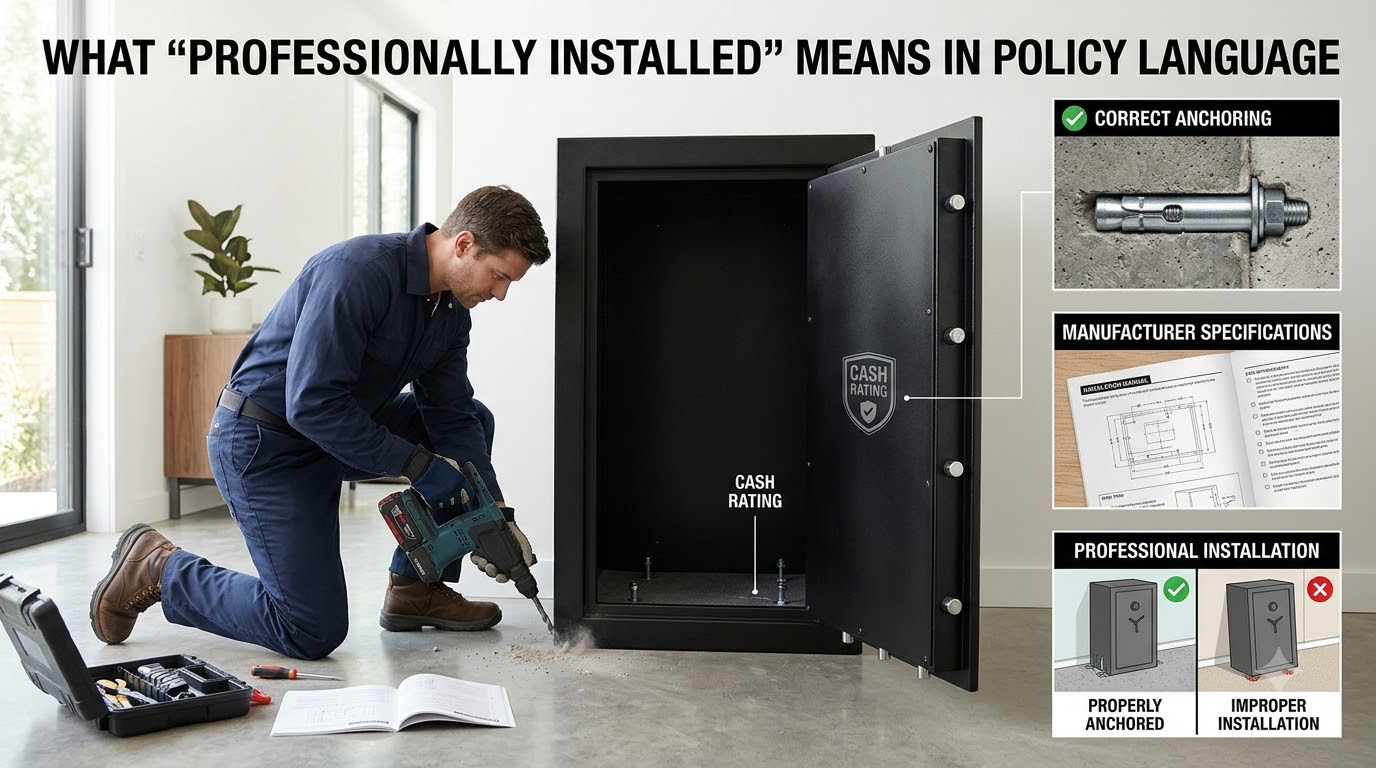
Insurers use the phrase freely, but they rarely define it in plain terms for the customer. Understanding what the language actually requires helps you meet the standard before you ever need to make a claim.
Anchoring and correct substrate
Proper anchoring means the safe is bolted into a structural surface capable of holding it, whether that is a concrete slab, a timber floor with suitable reinforcement, or a masonry wall. The substrate determines the fixings and the technique. A safe dyna-bolted into a thin tiled surface may look secure but offers little real resistance, and an assessor will recognise the difference immediately.
Manufacturer and insurer specifications
Safes ship with manufacturer instructions specifying how and where the unit should be fixed, and insurers expect those instructions to be followed to the letter. Deviating from them, even with good intentions, can void both the manufacturer’s warranty and your cover.
Aligning the installation with both the maker’s specifications and your insurer’s requirements keeps the two sets of rules working together rather than against you.
Cash rating and correct installation
Your safe’s cash rating tells the insurer how much cash and valuables can be stored inside for cover to apply, but that rating assumes the safe is installed as intended. An incorrectly fitted safe can effectively lose the protection its rating promises, because the rating and the anchoring are treated as a package.
Weighing up cheaper safes against genuine quality safes shows how closely cash ratings and build quality are tied to the protection you end up with.
DIY installation and policy breaches
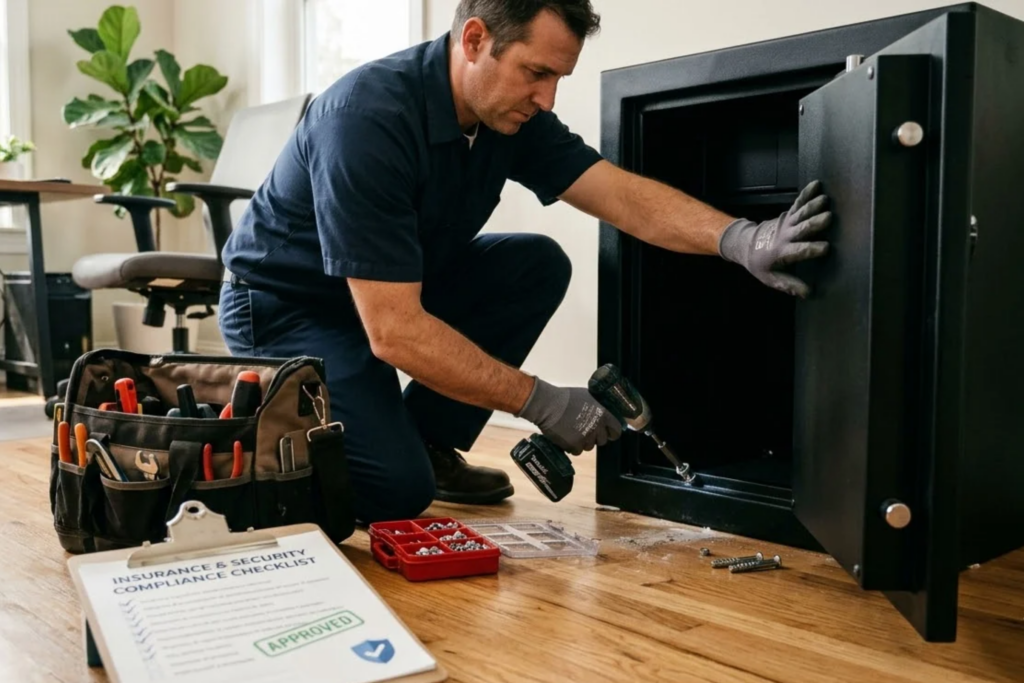
A do-it-yourself installation is where most claims quietly unravel. Fixing a safe yourself might feel like a sensible saving, yet without the right tools, substrate assessment, and knowledge of the standards, it is easy to breach a policy condition realising it. The cost of a rejected claim dwarfs the cost of professional fitting, and that trade-off is rarely obvious until it is too late.
The Documentation a Professional Installation Provides
The quiet advantage of professional installation is the paperwork it leaves behind. A qualified installer records what was done, how the safe was anchored, the substrate it was fixed into, and confirmation that the work followed AS/NZS standards and manufacturer guidance. This documentation typically covers the safe’s make, model, and cash rating, the fixing method used, and a dated record of the completed job.
If a claim is ever questioned, this record becomes your strongest piece of evidence, turning a subjective dispute into a matter of verifiable fact. It is the difference between telling your insurer the safe was installed correctly and being able to prove it.
How Precision Safes Protects Your Claim
At Precision Safes, we treat installation as part of your security, not a box to tick after delivery. Our approach is built around making sure your cover holds when it counts.
Installation to manufacturer and insurer specifications
Every job begins with a site assessment of your wall or floor type before a single fixing goes in. Our licensed technicians anchor each unit in line with the manufacturer’s instructions and AS/NZS requirements, so the safe performs exactly as its rating promises. Our professional safe installation service plans each project around your space, your substrate, and your security needs.
Documentation you can hand to your insurer
Where you need them, we provide detailed records of the completed installation that you can pass straight to your insurer. This documentation demonstrates that your safe was fitted to the required standard, giving you something concrete to rely on if a claim is ever assessed.
The same standard for homes and businesses
Whether we are fitting a compact unit from our range of home safes or a heavy commercial installation, the standard does not change. Businesses storing cash, stock, or sensitive records in our commercial safes receive the same careful anchoring, compliance checks, and record-keeping that protect a residential customer’s claim.
What to Check With Your Own Insurer
Policies differ, so it pays to confirm the details before you assume you are covered. A short conversation with your insurer can save a great deal of trouble later. Before or shortly after installation, it is worth asking about a few specifics:
- The cash and valuables limit that applies to items stored in your safe, and whether your safe’s rating meets it.
- Whether your policy requires the safe to be anchored or professionally installed for cover to apply.
- What documentation your insurer expects you to keep as proof of correct installation.
- Any conditions specific to the type of valuables you store, such as jewellery, firearms, or business cash.
Having these answers in writing means there are no surprises at claim time, and it lets your installer tailor the job to exactly what your policy demands.
Installation Is Part of Your Cover, Not an Afterthought
A safe is only as good as the way it is fitted. The steel might resist an attack, but if the unit was never properly anchored or the installation cannot be verified, your insurer may treat the loss as though the safe was never there. Professional installation closes that gap, aligning your safe with your policy conditions and leaving you with the documentation to prove it. If you want the confidence that your valuables are protected and your cover will hold, speak with the team at Precision Safes and we will make sure your safe is installed to the standard your insurer expects.