


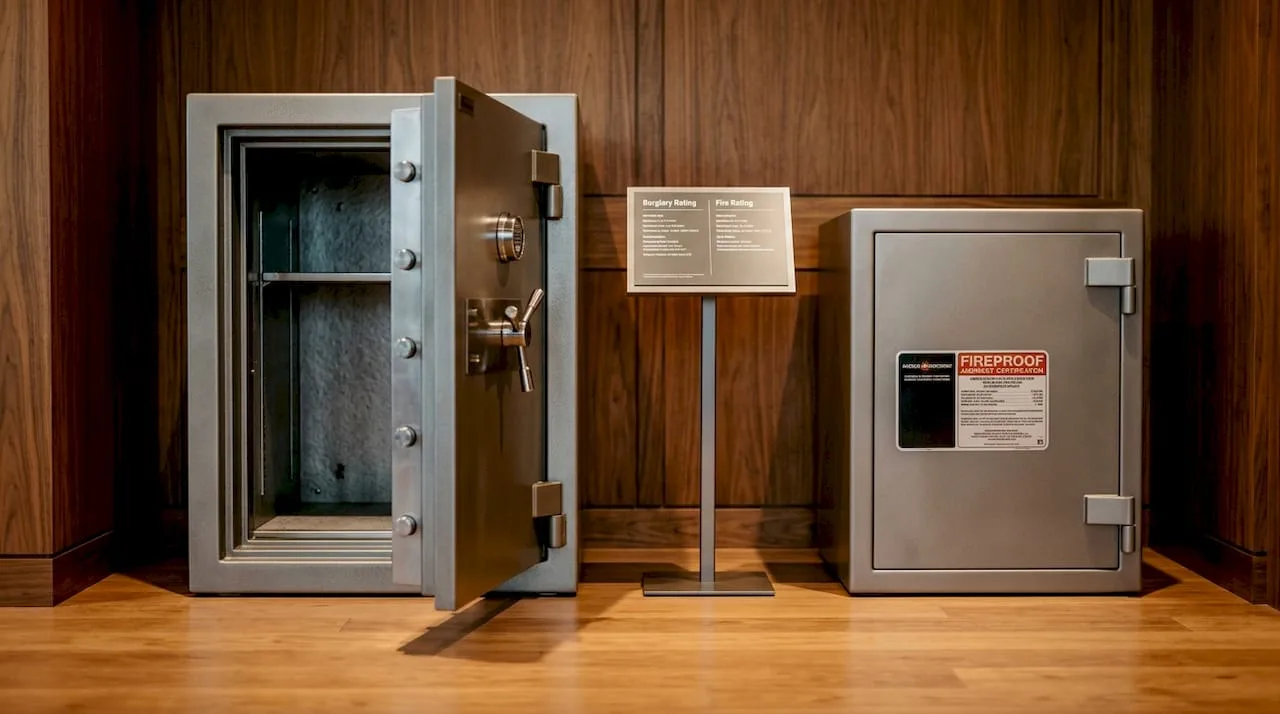
Choosing a safe sounds simple until you start seeing terms like cash rating, fire rating and TDR rating. Many buyers assume all safes offer the same level of protection, but the reality is very different. A safe designed to resist burglary may not provide strong fire protection, while a fire-resistant safe may not stop a determined thief.
Understanding safe ratings is one of the most important steps when buying a safe for your home or business. In this guide, Precision Safes explains what these ratings actually mean, how insurers use them, and which type of protection makes the most sense for your situation.
Why Safe Ratings Actually Matter
Safe ratings are not a marketing badge. They are certified, independently tested guarantees issued by accredited bodies against the Australian benchmark AS/NZS 3809, which governs how safes are assessed for burglary and fire resistance.
That certification plate inside the safe door matters for two reasons most buyers discover too late.
First, it tells you what the safe will be physically withstand. Second, it determines whether your insurance claim will be paid. Many home and business policies in Australia require contents to be stored in a rated, correctly installed safe before a claim can be honored. A safe without a verified rating could cost you the entire payout after a burglary or fire, regardless of how solid it looks.
“Heavy duty” and “solid steel construction” are marketing terms, not standards. If there is no certification plate, the safe has not been independently tested.
What Is a Cash Rating on a Safe?
A cash rating is an insurance concept, not a storage specification. It tells you the maximum value of cash and valuables your insurer will cover if a burglar successfully forces entry. The higher the cash rating, the greater the physical resistance and the more your insurer is prepared to back it.
In Australia, cash ratings on certified safes typically start from $5,000 at the entry level, with high-security commercial products reaching well into the hundreds of thousands. The right rating for your situation depends on what you are storing and what your insurer specifies. You can browse our home safes and office safes ranges to compare cash ratings side by side before purchasing.
How Insurance Companies Calculate a Cash Rating
Insurers assess a safe’s construction across several measurable criteria:
- Steel thickness across the door, walls, and body
- Boltwork including the number, size, and direction of locking bolts (four-way boltwork is substantially stronger than single-direction)
- Re-locking devices that engage automatically if someone attempts to drill or force the primary lock
- Lock quality including the grade and certification of the lock cylinder or electronic unit
- Barrier materials filling the door and wall cavities, such as concrete, steel mesh, or hardened alloy
A thin pressed-steel door with a single-direction bolt might earn a $10,000 cash rating. A 100mm slab door with four-way boltwork, anti-drill hardened plates, and a secondary re-locker can reach $100,000 or more. The difference is structural, not cosmetic.
Cash Ratings and Monitored Alarms: The Doubling Rule
Most insurers will double the effective cash rating when a monitored alarm system is installed on the premises. A safe rated at $30,000 in an unmonitored environment may therefore cover $60,000 in valuables when combined with a monitored alarm.
This is not automatic. You must confirm the doubling provision with your specific insurer before relying on it. The alarm must be active and monitored at the time of the incident, and the safe must still be correctly installed and locked. But for businesses that already invest in monitored security, this is a meaningful uplift that significantly changes which safe tier makes financial sense.
What Is a Fire Rating on a Safe?
A fire rating measures how long a safe’s contents stay protected from extreme heat, including the dangerous soak period after the flames are out when internal temperatures continue rising.
Fire-rated safes are tested to keep internal temperatures below two critical thresholds: 177°C for paper documents and 52°C for digital media such as hard drives and USB sticks. There is no such product as a fireproof safe. Every fire-rated safe is fire resistant for a certified window of time, and beyond that window, contents are at risk.
For anyone protecting wills, passports, title deeds, and digital backups, a fire-resistant safe is the baseline, not an optional upgrade. For document-heavy offices, our fire-resistant filing cabinets are worth a look too.
30 vs 60 vs 90 vs 120 Minutes: Which Do You Need?
The average residential house fire burns for 20 to 30 minutes before suppression. That makes a 30-minute fire rating the absolute minimum but only just. Delayed emergency response, multi-storey homes, and densely furnished rooms can extend exposure significantly.
|
|
|
|
|
|
|
|
If you are protecting digital media, note that not all fire-rated safes meet the 52°C data media threshold. Check the specification sheet rather than relying on the general fire rating alone.
The Fire Rating Trade-Off Most Buyers Miss
The construction features that make a safe excellent at resisting burglary actively work against fire protection, and vice versa. High-cash-rated safes rely on dense, heavy steel to defeat physical attacks. That same steel absorbs and retains heat during a fire, driving internal temperatures higher faster. This is why many high-cash-rated safes carry no fire rating at all, and why many fire-resistant safes offer only modest cash ratings.
Understanding this trade-off is the difference between buying the right safe and buying the wrong one for your situation.
What is a TDR Rating?
TDR stands for Torch and Drill Resistant, a specific construction classification used across the Australian safe and vault industry to describe the highest tier of physical security available in a commercial safe.
How TDR Construction Works
A TDR safe uses a high-strength barrier alloy embedded within the door and body, engineered to defeat the tools professional criminals carry: oxy-acetylene cutting torches, high-speed carbide drills, angle grinders, pneumatic and hydraulic spreading tools, and explosive force. The alloy resists these attacks by absorbing and redirecting energy rather than relying on sheer thickness alone.
Cash ratings on TDR products are substantially higher than standard cash-rated safes, reflecting the level of attack resistance they are built to withstand. In an unmonitored environment, these ratings are typically well above what most home and small business products offer — confirm the specific rating on any product before purchasing. These safes are substantial in weight and require professional floor anchoring. Our safe installation service handles delivery, positioning, and correct anchoring to manufacturer specification, which most insurers require for the rating to remain valid.
TDR vs Standard Cash-Rated Safes: A Real Difference
A standard cash-rated safe stops opportunist thieves and slows down most amateur attempts. It suits the vast majority of home and small business situations.
A TDR safe is built to defeat someone who arrives prepared with professional tools and a plan. If you are storing high-value jewellry, large ongoing cash holdings, or Schedule 8 controlled drugs, a standard cash-rated product is not meeting the threat level. TDR is not a luxury upgrade; it is the appropriate baseline for that risk profile. Our high security safes range covers TDR-rated products with full specifications.
Which Rating Do YOU Need? A Buyer-Type Decision Guide
Homeowners Protecting Documents, Jewellry and Cash
Most Australian homeowners need a dual fire and cash rated safe rather than choosing one or the other. Prioritize a 60-minute fire rating for documents and a cash rating of $10,000 to $30,000 for jewellry and cash. Check your home insurance policy before buying, as many require a minimum rating and professional installation. Our safe installation team ensures anchoring meets both manufacturer and insurer requirements.
Small Businesses Handling Daily Cash
Cafes, restaurants, and retail stores managing a daily cash float should treat cash rating as their primary concern. A minimum $30,000 to $60,000 cash rating is a sensitive starting point, with the monitored alarm doubling provision potentially removing the need to step up to the next tier. A deposit safe or commercial safe with a verified cash rating and professional installation is the core requirement.
Pharmacies, Jewelers and High-Value Retail
For pharmacies storing Schedule 8 drugs, jewelers holding stock, and high-turnover businesses with large ongoing cash holdings, a TDR-rated safe is the appropriate minimum. Legal compliance requirements, the value of goods, and the professional nature of targeted theft all push the required security level beyond standard cash-rated products. Our drug safes range includes products designed specifically for pharmaceutical compliance and high-security environments.
Can One Safe Do Everything?
Dual-Rated Safes: Fire + Cash Rating Combined
Yes, and they are increasingly worth the investment. Dual-rated safes carry both an independently certified cash rating and a fire rating, tested separately to different standards. They eliminate the cost, space, and confusion of running two separate safes and remove any ambiguity about which product your insurer expects you to use.
When to Prioritize One Rating Over the Other
If your contents are irreplaceable documents, passports, and digital backups, prioritize fire rating. A 60 to 90-minute certified fire-resistant product protects what matters most even if the cash rating is modest.
If you are holding physical valuables where theft is the primary risk, prioritize cash or TDR rating. Fire rating is a welcome secondary feature but should not reduce the burglary resistance you actually need.
When your situation changes, whether you move premises, expand your business, or update your insurance requirements, our safe relocation and safe removal services mean you are never stuck with a setup that no longer works.
Final Checklist Before You Buy
Before you commit to anything safe, work through these questions:
- What am I storing? Documents and digital media need fire rating. Cash, jewellry, and physical valuables need cash or TDR rating.
- What does my insurer require? Ask before you buy. Minimum rating, installation method, and alarm requirements vary by policy.
- What is my primary risk? Fire or burglary. Let that answer drive your rating priority.
- Is the safe certified to AS/NZS 3809 or an equivalent standard? No certification plate means no independent testing.
- Will it be professionally installed? Most insurers make correct installation a condition of coverage. Our professional teamhandles this correctly from day one.
- Do I have a monitored alarm? Confirm with your insurer whether this doubles your effective cash rating.
- Do I need ongoing support? If your combination is lost or the mechanism needs servicing, our safe repair and opening service is there when you need it.
Getting the rating right is not about buying the most expensive option. It is about matching the certified protection to the actual risk you face. That is what keeps your claim valid, your contents safe, and your investment worthwhile. With over 350 safes across our Tullamarine facility, our team can assess the right rating for your specific situation in person or over the phone 0409 860 011
