AUSTRALIA'S LARGEST RANGE OF ONLINE SAFES & VAULTS

Sales - Service - Installation

Largest Selection of safes

Australia's Most Trusted Supplier

Fast Delivery

Expert Installation

Unbeatable Deals

How Much Does It Cost to Relocate a Safe in Melbourne? What Affects the Price

Home   /   How Much Does It Cost to Relocate a Safe in Melbourne? What Affects the Price

It’s the first question almost everyone asks before booking: how much will it cost to move my safe? The honest answer is that there’s no single figure, because no two safe moves are quite the same. A small home safe shifted to the next room is a very different job to a half-ton commercial unit carried down a flight of stairs and across the city.

Understanding what drives the price helps you judge whether relocation is the sensible choice or whether buying new makes more sense, and it puts you in a far better position when you ask for a quote.

Why There’s No Flat Price for Safe Relocation

A safe move is priced per job because the work behind it varies so much from one home to the next. Shifting a 50kg home safe across a single room shares almost nothing with relocating a 400kg commercial unit down two flights of stairs, yet a flat rate would treat them the same.

The weight, the floors at each end, the access, and the distance all move the figure independently, so a price quoted before any of that is known is really just a guess, and usually one that creeps upward once the crew sees what’s actually involved. This is why a proper safe relocation starts with a few questions about your safe and your property rather than a number off a price list.

What Affects the Cost of Relocating a Safe
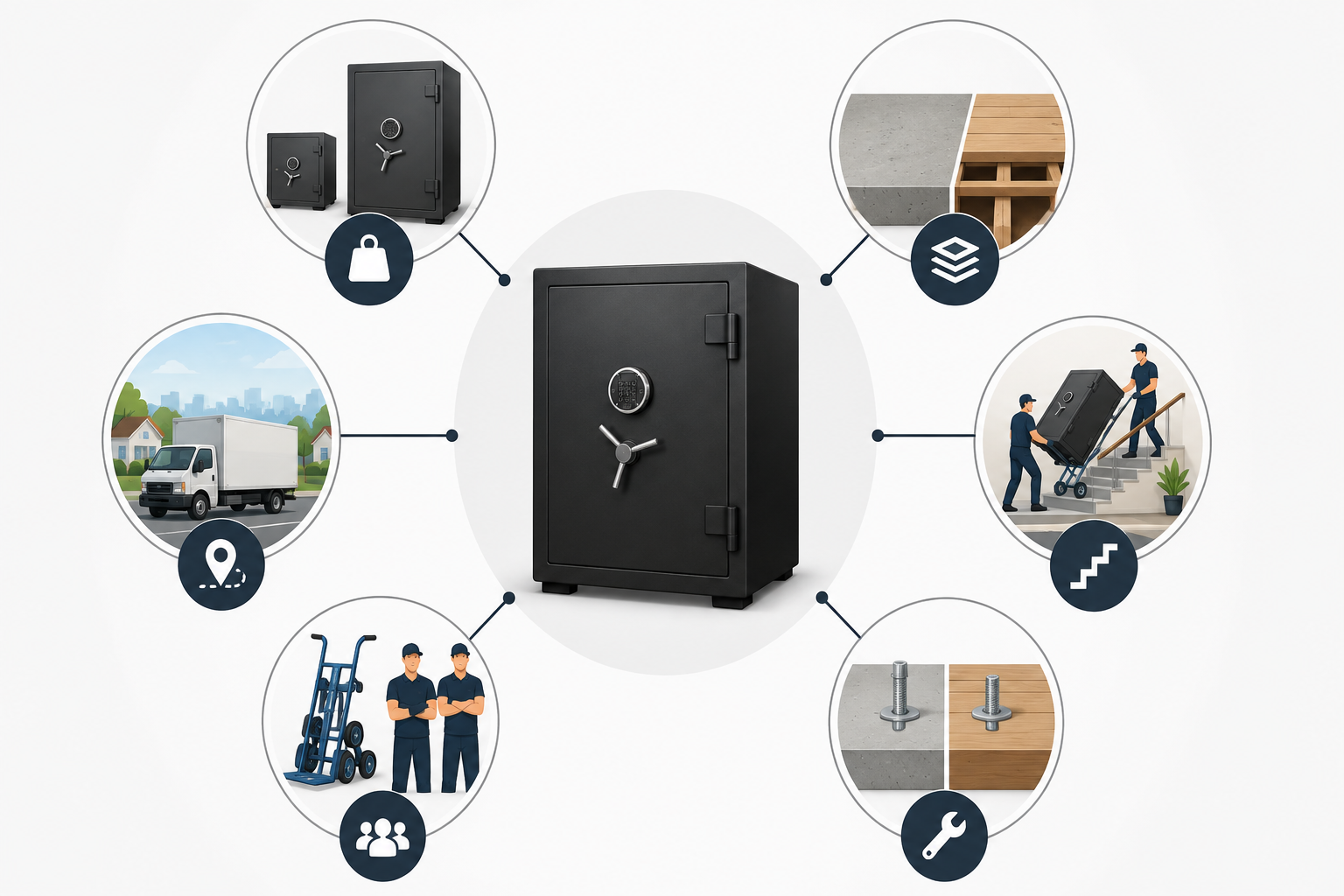
Several things feed into the final price, and most jobs involve a mix of them. Knowing what they are makes your quote easier to read and shows you where the real work sits.
safe relocation cost factors including weight access distance and anchoring

The Weight and Size of the Safe

Weight is the single biggest driver. A compact home safe can be handled with minimal gear, while a heavy commercial or high security safe needs specialised lifting equipment and more people to shift it safely. Larger units are also harder to manoeuvre through doorways and around corners, which adds time at both ends of the move.

Floor Type at the Origin and Destination

The surfaces at each end matter. Anchoring into a concrete slab is straightforward, but a timber subfloor takes more planning to fix into securely. When the origin and destination floors differ, the re-anchoring has to be reworked from scratch, which affects both the labour and the materials needed.

Access Constraints and Stairs

A clear ground-floor path is the easy scenario. Narrow hallways, tight corners, steep driveways, and stairs in particular all raise the difficulty and the risk, calling for more crew and slower, more careful handling. A safe that has to travel up or down a level is a much bigger job than one wheeled straight out to the van.

Travel Distance Between Locations

The gap between the old and new property plays a part too. A move within the same suburb is simpler than one across greater Melbourne, where travel time, fuel, and scheduling start to add up. Distance rarely sets the price on its own, but it shifts the total.

Crew Size and Specialist Equipment

Heavier or more awkward jobs need more hands and more gear. Stair-climbing trolleys, lifting equipment, and protective material all come into play on bigger moves, and the crew scales with the weight and the access difficulty. Spending here is what protects the safe and your home from a job done short-handed.

De-Anchoring and Re-Anchoring

Releasing the safe from its current spot and securing it properly at the new one is skilled work in its own right. How the existing anchoring was done, and what the destination floor calls for, both affect how long this stage takes. It’s also the part most worth paying for, since correct anchoring is what keeps the safe difficult to remove.

What the Safe Relocation Process Involves
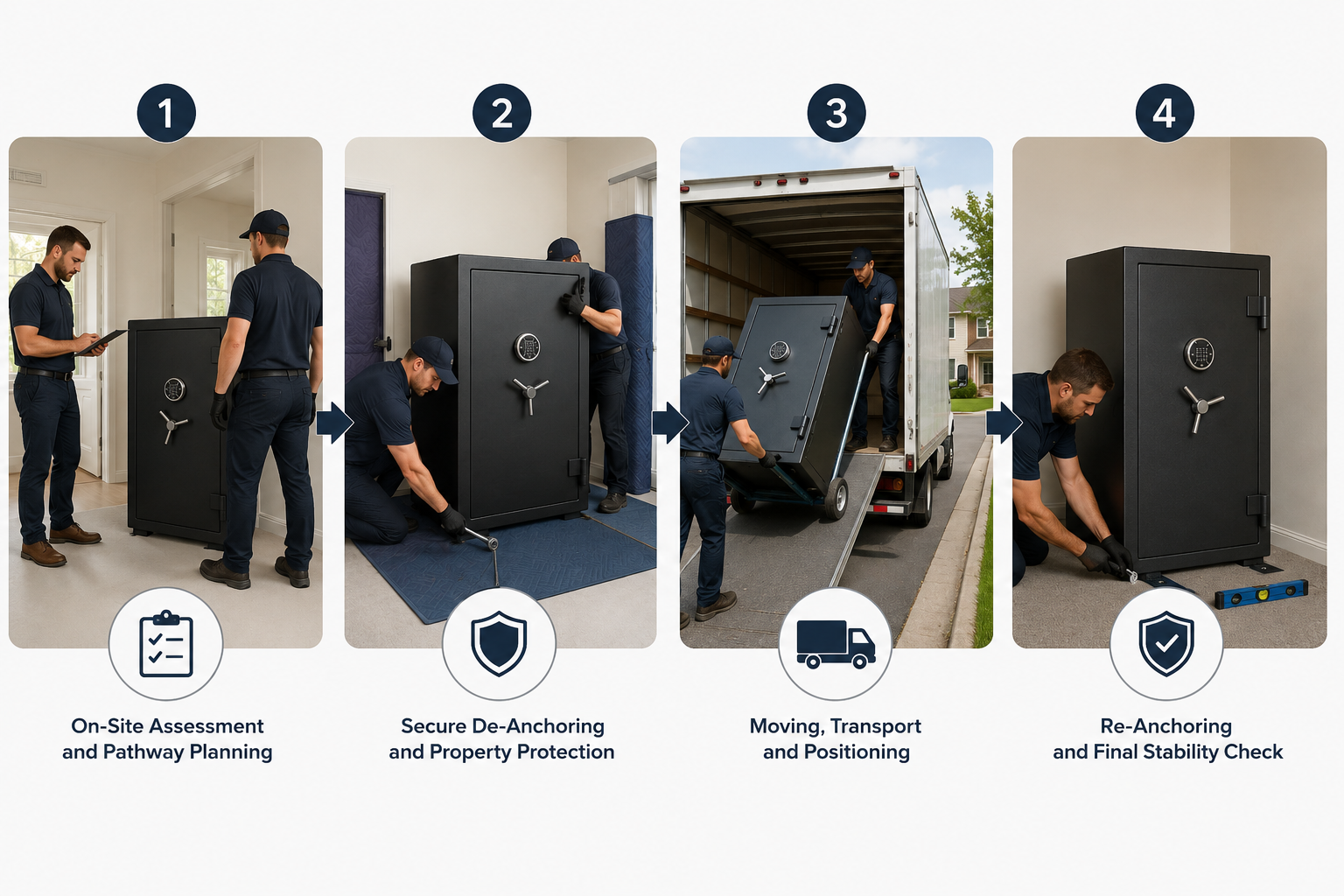
Seeing what actually happens on the day makes the price easier to weigh up. A proper relocation moves through four clear stages.
four stages of professional safe relocation from assessment to re-anchoring

On-Site Assessment and Pathway Planning

It starts with a look at the safe, the floors at both ends, and the route in between. Mapping the path beforehand means the crew turns up with the right equipment and no nasty surprises, which is what keeps the quoted price accurate.

Secure De-Anchoring and Property Protection

The safe is released from its anchoring cleanly, while floors, walls, and doorways along the route are protected as it goes. This is the stage that heads off the dents and scratches a rushed, unprotected move tends to leave behind.

Moving, Transport and Positioning

With the right trolleys and lifting gear, the team works the safe out, transports it securely, and brings it into the new property. Getting the positioning right here sets up the final anchoring to be done cleanly.

Re-Anchoring and Final Stability Check

At the new spot the safe is re-anchored to suit that particular floor, levelled, and checked for stability, with the lock tested to confirm it still operates smoothly. This carries the same care as a first-time safe installation, because the job isn’t really done until the safe holds as firmly as it did before.

Why Cheap Relocation Ends Up Costing More

A bargain quote is tempting, but moving a safe is one job where cutting corners rarely pays off. An underquoted crew without the right gear can scratch floors, damage walls, drop a unit, or leave the safe poorly anchored, and putting any of that right quickly wipes out the saving.

A safe that isn’t anchored correctly is also far easier to remove, which undoes the very reason you bought it. The same thinking that separates cheap safes from quality ones applies to the service that moves them: paying for the work to be done properly protects both the safe and everything inside it.

This is usually where the relocate-versus-replace question comes in. For a quality safe in good condition, professional relocation tends to work out cheaper than buying and installing a brand-new unit. Replacing makes more sense when the safe is old, damaged, no longer suits your needs, or when a tricky access situation makes moving it genuinely impractical. If the existing unit was a budget model to start with, a fresh safe removal and an upgrade can be the smarter spend.

Determining the Cost of Your Safe Move

Because so much comes down to your particular safe and the two properties involved, the only way to land on a real figure is to have it looked at properly. A quick assessment of the weight, the floors at both ends, and the access route is usually all it takes to turn the variables into a firm number.

Give the team at Precision Safes the details of your safe and where it’s headed, and you’ll get a clear quote upfront that still holds when moving day arrives. Call 0409 860 011 or get in touch to find out what your Melbourne safe relocation will cost.